
CATALG — publish catalogs
This page tells you what CATALG does and how it fits into a Fabric network.
Fabric CATALG is the shared catalog publication and distribution service of the Fabric ecosystem. Providers publish their catalogs to CATALG once, and CATALG validates them and pushes them out to every Discovery Service subscribed to that network.
This page tells you what CATALG does and how it fits into a Fabric network. When you are ready to send your first publish request, jump to the Quickstart.
The problem
Without a shared catalog backbone, Fabric networks fragment quickly:
Every provider publishes through a different mechanism
Discovery Services maintain stale, inconsistent copies of the same data
There is no network-wide view of what is live, valid, or active
Every provider reinvents product definitions independently
The result is duplicated effort, inconsistent search results, and no canonical source of truth.
What CATALG does
CATALG sits between Provider Nodes (the participants that publish catalogs) and Discovery Services (the search layer that consumer applications query). It gives the network:
One place to publish — every catalog flows through a single validated pipeline
Automatic distribution — every accepted catalog is pushed to all subscribed Discovery Services within seconds
Schema-aware validation — catalogs are checked against the Fabric v2.0 schema and any domain overlays before acceptance
Network-wide templates — a network can publish canonical resource definitions that providers extend, ensuring data consistency across the network
Granular visibility control — publishers can restrict delivery to specific network participants
CATALG is not a query engine. It is the source of truth for what is published. Consumer applications never call CATALG directly — they query a Discovery Service, which keeps its data current by subscribing to CATALG.
High-Level Architecture
How it works end-to-end
The full lifecycle — from a Discovery Service setting up its subscription, through a network publishing master templates, to a provider publishing a real catalog and a consumer discovering it:
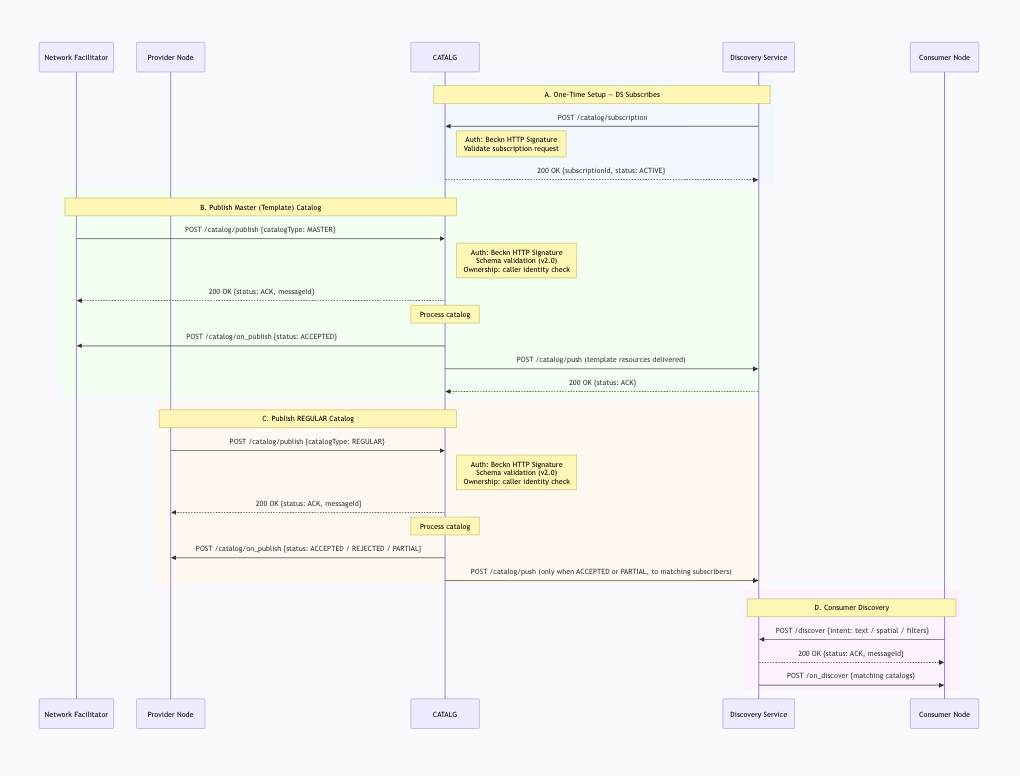
Key points:
Subscription is synchronous — CATALG returns
subscriptionIdandstatus: ACTIVEdirectly in the 200 OK responsePublish ACK is synchronous — returned immediately once the request passes authorization and schema checks
on_publishis asynchronous — notifies the publisher of the per-catalog result (ACCEPTED / REJECTED / PARTIAL)catalog/pushis synchronous — CATALG POSTs to each matching Discovery Service and receives an immediate ACK or NACK; delivered only when the catalog is ACCEPTED or PARTIALon_discoveris asynchronous — Discovery Service calls the Consumer Node'sbapUriwith matching results
Where you fit
You are… | Start here |
|---|---|
A Provider Node publishing catalogs | |
A Discovery Service builder receiving catalogs | |
A Network Facilitator defining templates | |
Just looking up an endpoint |
Example use case
A multi-brand EV charging network wants to list all its charging stations nationwide. The network facilitator first publishes a master (template) catalog defining canonical charging resource schemas — connector types, power levels, tariff structures.
Each charging operator then publishes a REGULAR catalog extending the master templates, adding their specific stations, live availability, and pricing. CATALG validates every submission and automatically pushes accepted catalogs to all subscribed Discovery Services.
One such Discovery Service — Fabric DISCOVR — makes the data available for discovery. A mobility app queries DISCOVR for "CCS2 chargers above 50 kW near Bangalore" and gets real-time results from multiple operators in a single response.
Next: Quickstart — Publish Your First Catalog →
The Fabric capability: Cataloguing
CATALG realises the Fabric Cataloguing capability — a canonical surface for publishing offerings (items, prices, providers, locations, terms) to the entire network in one motion. Catalogues live in Fabric; transactions happen off it.
What it gives you
Publish once — one source of truth, network-wide reach.
Provider identity — every offering tied to a Registry identity.
Structured schemas — typed items, prices, terms, quantities, geos.
Versioning — offerings change without breaking subscribers.
Multi-network publishing — the same offering can appear in multiple networks via policy.
Where it sits — a service NFH runs (the cataloguing surface where providers publish) plus the protocol NFH defines (the schemas for offerings, items, and providers).
Standards alignment: Beckn Protocol v2 catalogue schemas · JSON-LD.